Skip to content
Fowler Lab
Fowler Lab

Predicting antimicrobial resistance

  • News
  • Publications
  • Members
  • Research
    • Overview
    • Manifesto
    • Software
    • Reproducibility
  • Teaching
  • Contact
    • PhDs
  • Wiki
Fowler Lab
Fowler Lab

Predicting antimicrobial resistance

New paper: predicting rifampicin resistance via free energy simulation
Philip Fowler, 23rd September 20253rd October 2025

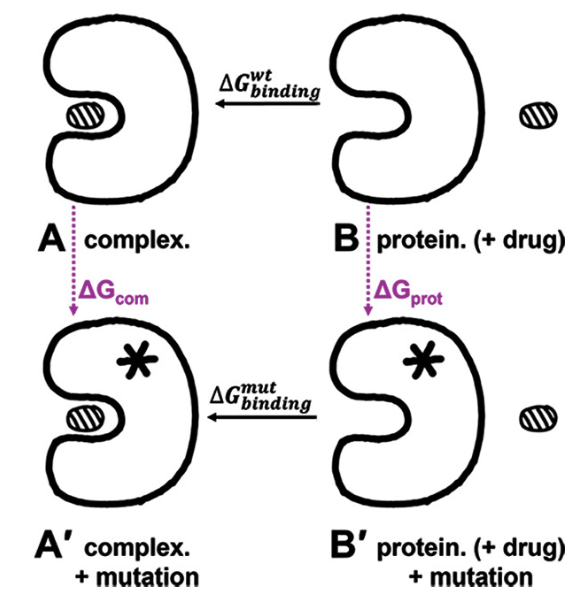
This work was carried out by Xibei Zhang, who is doing her PhD with Peter Coveney at UCL. It builds on earlier work I did using alchemical free energy methods to calculate whether individual mutations in the protein target of an antibiotic reduce how well the drug can bind, thereby conferring resistance. The method was first shown to work on DHFR in S. aureus and this was followed up by another paper looking to see just how fast we could do this (as the method is extremely computationally intensive so even with access to high performance computing takes a while to return a result). DHFR is a fairly small protein so proved the method but wasn’t a good test. So myself and Alice then tried the RNA polymerase and DNA gyrase in M. tuberculosis with mixed results, mainly due to the longer convergence time required due to the sheer size of the protein complexes.

Xibei has picked up the baton and applied their in-house free energy method, TIES_PM, to the RNA polymerase in this paper increasing the number of mutations considered from six to 61, in part through using the Polaris supercomputer at Argonne National Labs in the USA; it was the 12th fastest supercomputer on the planet back in 2021.

Hence whilst these methods remain computational expensive, they are getting more tractable, even for large protein complexes like the RNA polymerase, as computer processing power continues to increase, especially as molecular dynamics codes can run on GPUs which continue to get bigger and faster due to the current focus on artificial intelligence. We have proposed a few research projects and, should one be funded, hope to return to this idea in the near future.

Share this:

  • Share on X (Opens in new window) X
  • Share on Bluesky (Opens in new window) Bluesky
  • Email a link to a friend (Opens in new window) Email
  • Share on LinkedIn (Opens in new window) LinkedIn
  • Share on Mastodon (Opens in new window) Mastodon

Related

antimicrobial resistance computing GPUs molecular dynamics publication research tuberculosis

Post navigation

Previous post
Next post

Related Posts

New grant: Ox4TB

17th March 202517th March 2025

Very pleased to announce that I am a co-investigator on the recently announced Oxford4TB project…

Share this:

  • Share on X (Opens in new window) X
  • Share on Bluesky (Opens in new window) Bluesky
  • Email a link to a friend (Opens in new window) Email
  • Share on LinkedIn (Opens in new window) LinkedIn
  • Share on Mastodon (Opens in new window) Mastodon
Read More
molecular dynamics

Installing GROMACS with MPI support on a Mac

5th December 2014

GROMACS is an optimised molecular dynamics code, primarily used for simulating the behaviour of proteins….

Share this:

  • Share on X (Opens in new window) X
  • Share on Bluesky (Opens in new window) Bluesky
  • Email a link to a friend (Opens in new window) Email
  • Share on LinkedIn (Opens in new window) LinkedIn
  • Share on Mastodon (Opens in new window) Mastodon
Read More
computing

Software Carpentry Feedback

1st November 2012

As well as asking the attendees how they thought the workshop had gone, I sent them…

Share this:

  • Share on X (Opens in new window) X
  • Share on Bluesky (Opens in new window) Bluesky
  • Email a link to a friend (Opens in new window) Email
  • Share on LinkedIn (Opens in new window) LinkedIn
  • Share on Mastodon (Opens in new window) Mastodon
Read More

Leave a Reply Cancel reply

Your email address will not be published. Required fields are marked *

This site uses Akismet to reduce spam. Learn how your comment data is processed.

Privacy & Cookies: This site uses cookies. By continuing to use this website, you agree to their use.

To find out more, including how to control cookies, see here: Cookie Policy
    ©2026 Fowler Lab | WordPress Theme by SuperbThemes

    Loading Comments...