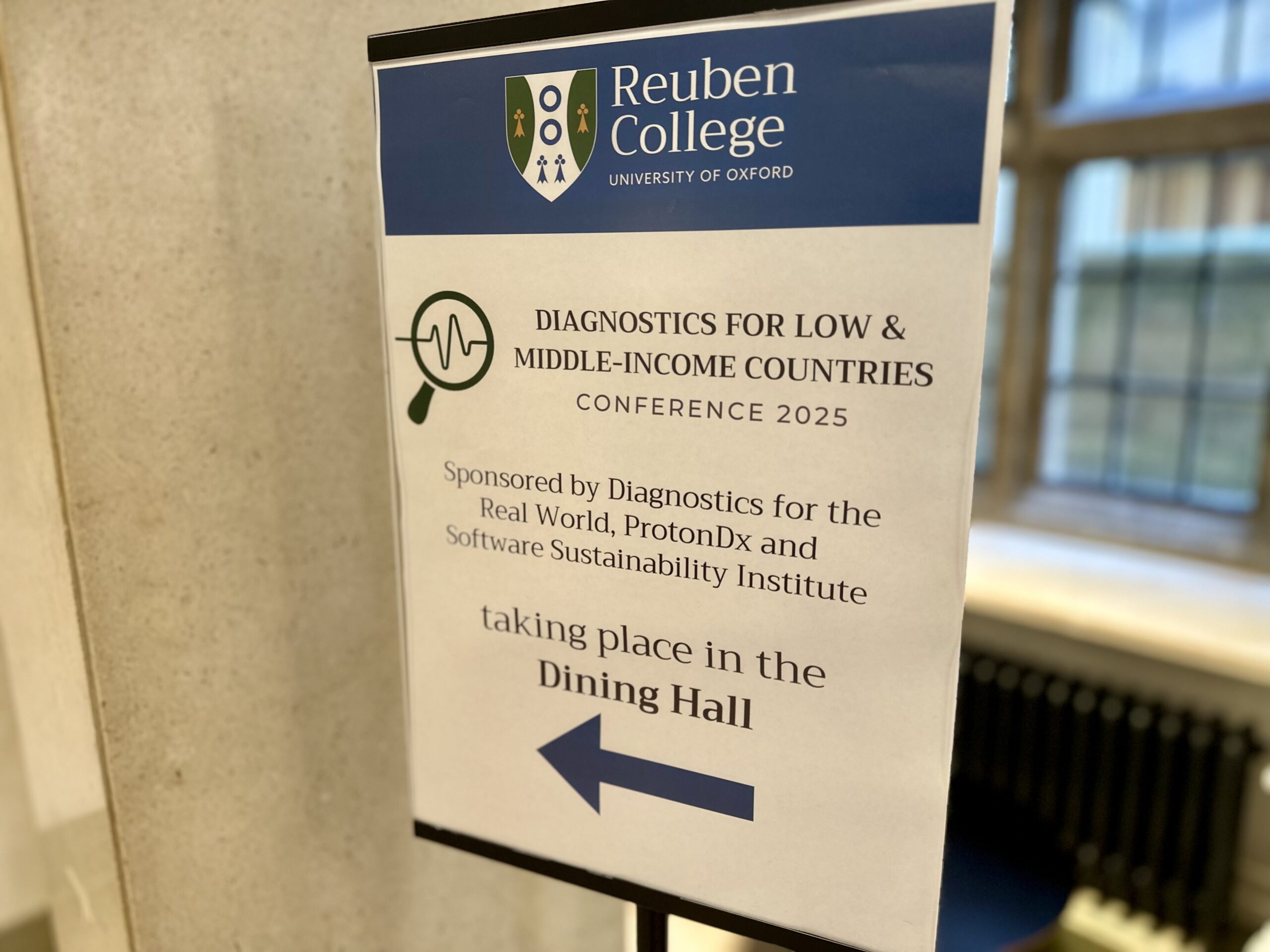
Third Dx4LMICs conference Philip Fowler, 3rd July 20257th July 2025 Most of us attended the third Diagnostics for Low- and Middle-Income Countries (Dx4LMICs) conference at Reuben College in Oxford over the last two days. I am a Fellow at Reuben College and helped our President, Professor Lord Lionel Tarassenko and several others, including Dylan Adlard, organise the conference. It was the biggest conference the college has held to date with about 110-120 attendees and we had to close registration a few weeks before and had a waiting list. It was also the hottest conference we’ve ever had with the temperature being over 30°C outside and I am sure the hall was even hotter, or at least more humid. Dylan Adlard put in a lot work helping to make the conference a success; he used his SSI Fellowship to pay for accommodation for around 20 PhD students from UCL so they could attend the conference and two poster prizes. He also ran a successful online workshop the day before the conference started looking at and understanding the available ECG datasets that researchers are using the train machine learning models to detect Chagas disease. That said, the talks were not only very diverse but also very interesting. We heard about using machine learning to transcribe patient histories, bioengineering methods that let you run multiple PCR reactions in a single well, potentially making diagnostic tests much cheaper and faster and the detection of patient deterioration in Vietnam by machine learning models inspecting pulse oximeter data. Hopefully we will run a fourth edition in 2026! Share this: Share on X (Opens in new window) X Share on Bluesky (Opens in new window) Bluesky Email a link to a friend (Opens in new window) Email Share on LinkedIn (Opens in new window) LinkedIn Share on Mastodon (Opens in new window) Mastodon Related group meetings
antimicrobial resistance New preprint: compensatory mutations are associated with increased growth in resistant samples of M. tuberculosis. 22nd June 20238th December 2023 In this preprint, Viki Brunner shows how, using the large CRyPTIC dataset, she can recapitulate… Share this: Share on X (Opens in new window) X Share on Bluesky (Opens in new window) Bluesky Email a link to a friend (Opens in new window) Email Share on LinkedIn (Opens in new window) LinkedIn Share on Mastodon (Opens in new window) Mastodon Read More
antimicrobial resistance Diagnosing antibiotic resistance: future trends? 23rd April 20175th August 2018 It is Sunday, I’m in Vienna at the European Congress of Clinical Microbiology and Infectious… Share this: Share on X (Opens in new window) X Share on Bluesky (Opens in new window) Bluesky Email a link to a friend (Opens in new window) Email Share on LinkedIn (Opens in new window) LinkedIn Share on Mastodon (Opens in new window) Mastodon Read More
antimicrobial resistance New preprint: Predicting pyrazinamide resistance in M. tuberculosis using a graph convolutional network 29th October 202530th October 2025 In previous work we’ve used “traditional” machine-learning approaches, like XGBoost, to learn and therefore predict… Share this: Share on X (Opens in new window) X Share on Bluesky (Opens in new window) Bluesky Email a link to a friend (Opens in new window) Email Share on LinkedIn (Opens in new window) LinkedIn Share on Mastodon (Opens in new window) Mastodon Read More