Fowler Lab
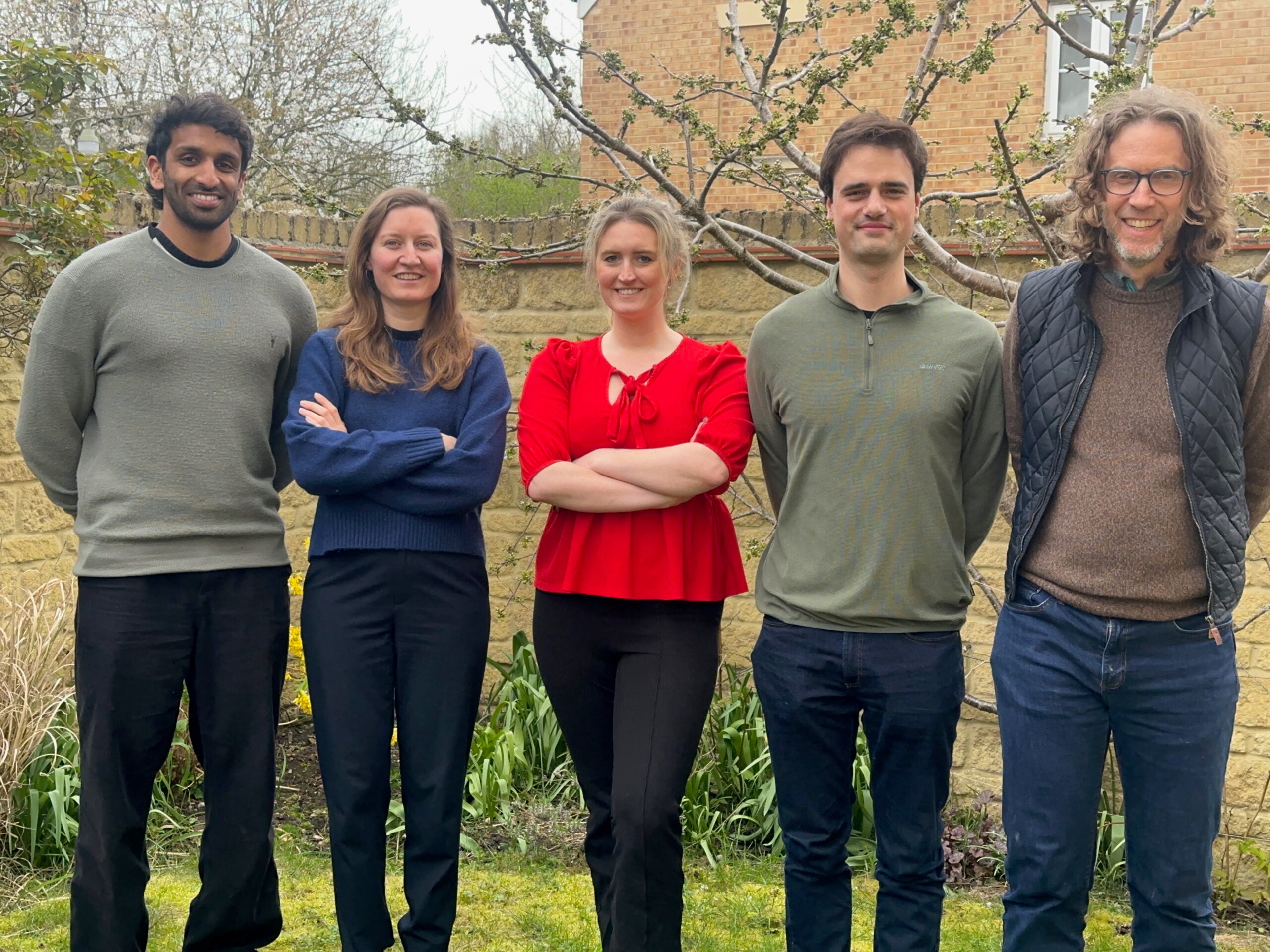
[Dylan Dissanayake, Viktoria Brünner, Melody Parker, Dylan Adlard and Philip Fowler]
Predicting antimicrobial resistance
Overview
 Probably the easiest way to describe what we do is to explain our logo. The capsules are the easiest part to explain; they are antimicrobials because we study how to better diagnose and treat antimicrobial infections. But the duck? Well, that refers to “rubber duck debugging” which is a remarkably effective way of solving your problems in your computer code by explaining them to… a rubber duck. If we put all that together, we use computational methods to study antimicrobial resistance. Hence everyone who joins the group gets their very own rubber duck.
More specifically, we develop methods that can predict whether a particular clinical sample will be susceptible or resistant to a specific antimicrobial. Most often that means inspecting genetic information derived from the sample and e.g. predicting what the effect of a specific mutation or allele has on an antimicrobial. Broadly speaking, our methods divide into inference and deduction. The former range from statistical association allowing catalogues of known resistance-associated variants to be built but it also includes the use of machine learning and artificial intelligence. We are especially interested in making use of information derived from the structure of the drug target as we believe that is a rich source of information that is often ignored. The latter uses molecular simulation (a physics-based deduction approach) to, usually, calculate how a mutation affects the binding free energy of the antimicrobial. This is more expensive but does not require a large training dataset so is most likely to find application in early drug development to reduce the probability of resistance emerging.
Much of this work requires large, high quality datasets and therefore we also curate the CRyPTIC dataset which is the world’s largest open dataset of Mycobacterial samples with paired whole genome sequencing and phenotypic drug susceptibility data. As part of that work we also work on methods that improve the accuracy and precision of reading minimum inhibitory concentrations from 96-well broth microdilution plates.
We are part of the Modernising Medical Microbiology Unit in the [Nuffield Department of Medicine[(https://www.ndm.ox.ac.uk)] at the University of Oxford. Practically we are based on L7 of the John Radcliffe Hospital next to the OUH Microbiology Department. The group is led by Philip Fowler.
News
Postdoctoral researcher position advertised
Advances in Computational Approaches to Antimicrobial Resistance Meeting
Advances in Computational Approaches to Antimicrobial Resistance Meeting
New paper: Call for sharing phenotypic drug susceptibility data
DPhil projects in antibiotic resistance
Community reviews on our neonatal outbreak preprint
RESPECT-TB launched!
New paper: Validation of an optimized Oxford Nanopore sequencing workflow versus Illumina for mycobacteria from primary MGIT culture
Recent publications
- Adlard D, Malone KM, Westhead J, Hunt M et al (2026).
Rapidly and reproducibly building a comprehensive catalogue of resistance-associated variants for M. tuberculosis.
accepted for publication in Lancet Microbe
bioRxiv preprint doi:10.1101/2025.10.02.679941
- Holt KE, Berends MS, Chindelevitch L, Couto N et al (2026).
A call for sharing phenotypic antimicrobial susceptibility data alongside bacterial genome sequence data in public archives.
npj Antimicrob Resist doi:10.1038/s44259-026-00278-5
Zenodo preprint doi:10.1038/s44259-026-00278-5
- Baker CS, Colpus M, Gentry J, Hall A et al (2026).
Validation of an optimized Oxford Nanopore sequencing workflow versus Illumina for mycobacteria from primary MGIT culture.
Microbiology Spectrum doi:10.1128/spectrum.01402-26
bioRxiv preprint doi:10.64898/2026.02.04.703726
- Baranowski C, Cortade DL, Adler B, Bayliss S et al (2026).
Predicting Quantitative MIC from Whole Genome Sequencing.
Zenodo preprint doi:10.5281/zenodo.21456141