Skip to content
Fowler Lab
Fowler Lab

Predicting antibiotic resistance de novo

  • News
  • Publications
  • Members
  • Research
    • Overview
    • Manifesto
    • Software
    • Reproducibility
  • Teaching
  • Contact
    • PhDs
  • Wiki
Fowler Lab
Fowler Lab

Predicting antibiotic resistance de novo

New paper: Addressing pandemic-wide systematic errors in the SARS-CoV-2 phylogeny

Philip Fowler, 9th February 20269th February 2026

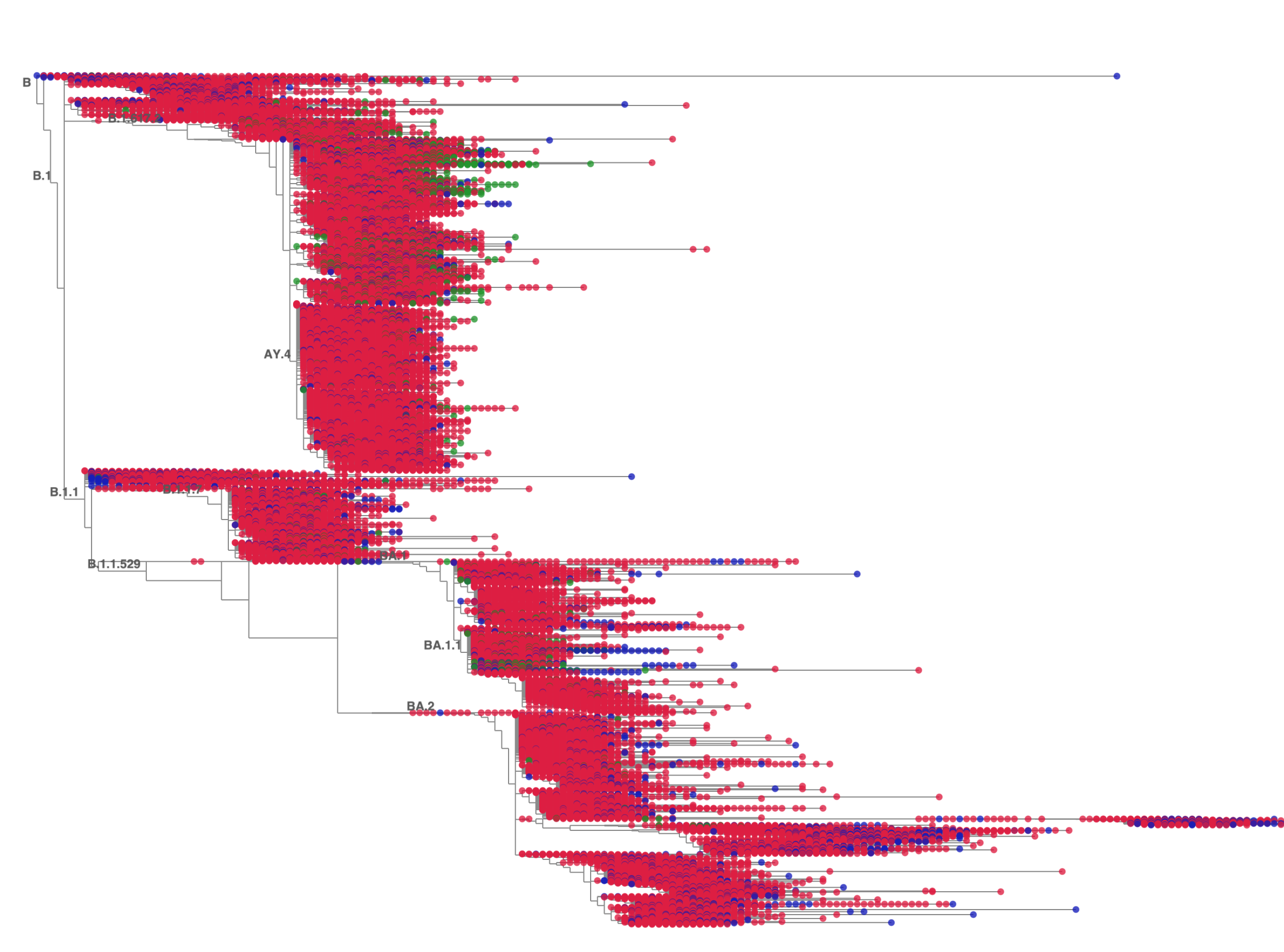
Zam Iqbal, at the University of Bath, led this epic study published today in Nature Methods where we assembled all SARS-CoV-2 genomes deposited in the European Nucleotide Archive before 2 March 2023. In total a staggering 4,395,655 samples were processed. Since SARS-CoV-2 was almost always sequenced using tiled amplicons (e.g. ARTICv3), he and his team wrote viridian which is a variant caller that identifies the amplicon scheme used and then uses that information to avoid making spurious calls. The resulting phylogenetic tree is much more consistent than other trees built from publicly-available consensus sequences. You can explore the huge phylogenetic tree in detail here.

Share this:

  • Share on X (Opens in new window) X
  • Share on Bluesky (Opens in new window) Bluesky
  • Email a link to a friend (Opens in new window) Email
  • Share on LinkedIn (Opens in new window) LinkedIn
  • Share on Mastodon (Opens in new window) Mastodon

Related

clinical microbiology publication

Post navigation

Previous post
Next post

Related Posts

antimicrobial resistance

New preprint: looking at rifampicin-resistant subpopulations in clinical samples

10th April 202510th April 2025

Since clinical samples are usually grown in a MGIT tube for a while before some…

Share this:

  • Share on X (Opens in new window) X
  • Share on Bluesky (Opens in new window) Bluesky
  • Email a link to a friend (Opens in new window) Email
  • Share on LinkedIn (Opens in new window) LinkedIn
  • Share on Mastodon (Opens in new window) Mastodon
Read More
publication

New Publication: Energetics of Multi-Ion Conduction Pathways in Potassium Ion Channels

31st October 2013

Can we predict the conductance of a potassium ion channel from an experimental structure? In this…

Share this:

  • Share on X (Opens in new window) X
  • Share on Bluesky (Opens in new window) Bluesky
  • Email a link to a friend (Opens in new window) Email
  • Share on LinkedIn (Opens in new window) LinkedIn
  • Share on Mastodon (Opens in new window) Mastodon
Read More
antimicrobial resistance

AMyGDA now available from GitHub

27th January 202027th January 2020

AMyGDA is a python module that analyses photographs of 96-well plates and, by examining each…

Share this:

  • Share on X (Opens in new window) X
  • Share on Bluesky (Opens in new window) Bluesky
  • Email a link to a friend (Opens in new window) Email
  • Share on LinkedIn (Opens in new window) LinkedIn
  • Share on Mastodon (Opens in new window) Mastodon
Read More

Leave a Reply Cancel reply

Your email address will not be published. Required fields are marked *

This site uses Akismet to reduce spam. Learn how your comment data is processed.

Privacy & Cookies: This site uses cookies. By continuing to use this website, you agree to their use.

To find out more, including how to control cookies, see here: Cookie Policy
    ©2026 Fowler Lab | WordPress Theme by SuperbThemes