Skip to content
Fowler Lab
Fowler Lab

Predicting antibiotic resistance de novo

  • News
  • Research
    • Overview
    • Manifesto
    • Software
    • Reproducibility
    • Publications
  • Members
  • Teaching
  • Contact
    • PhDs
  • Wiki
Fowler Lab
Fowler Lab

Predicting antibiotic resistance de novo

New paper: how well can we predict AMR in tuberculosis samples?
Philip Fowler, 16th December 202516th December 2025

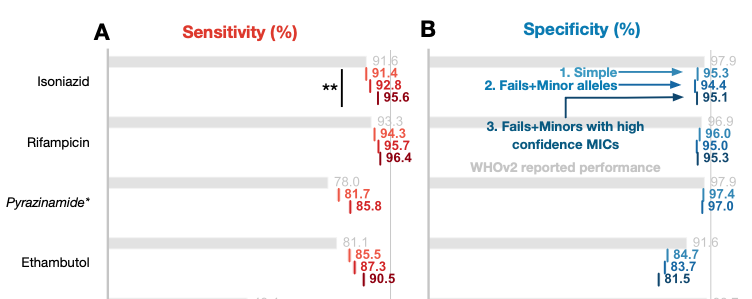
This paper just published in Microbial Genomics examines how well our software tool, gnomonicus, predicts to which antibiotics a clinical sample that has been whole-genome sequenced is resistant. To do so, it implements the second edition of the WHO catalogue of resistance-associated mutations (WHOv2) which in turn we had to, in effect, translate from the original Excel and PDF report. Hence we are partly checking our implementation of WHOv2.

Now we had originally wanted to call the tool gnomon as that is the part of a sundial that casts the shadow (thereby following our timekeeping theme: clockwork, sundial) but unfortunately by the time we registered the project on PyPi that name was taken so we ended up with gnomonicus which is a bit of a mouthful.

To characterise its performance, we created a dataset of 2,663 samples that is large enough to give a reasonable idea of performance partly by ensuring there is a good mix of resistance and susceptibility for all 15 antibiotics included in WHOv2. As a further check, we also compared the results of our approach with the results of TB-Profiler which is currently probably the best known TB tool. What was very gratifying was that out of the 13,821 predictions made by both tools, only 63 were truly discrepant (in the sense that one tool called Resistant and the other Susceptible for a drug) and when you dig into these you find that they are nearly all due to differences in the variants called by the upstream pipelines, rather than differences in how we have interpreted WHOv2.

That said, there are some clear differences in interpretation; for example we chose to return a result of Unknown if a mutation in a gene associated with resistance was detected that is not listed in WHOv2 as there is a non-zero chance that it confers resistance. This really illustrates the lack of guidance in the WHOv2 report on how to apply the catalogue in a real world scenario.

Our AMR prediction software stack (including gnomonicus and our implementation of WHOv2) is included in the Myco pipeline which is deployed in EIT GPAS — you can sign up and try it out here.

Share this:

  • Click to share on X (Opens in new window) X
  • Click to share on Bluesky (Opens in new window) Bluesky
  • Click to email a link to a friend (Opens in new window) Email
  • Click to share on LinkedIn (Opens in new window) LinkedIn
  • Click to share on Mastodon (Opens in new window) Mastodon

Related

antimicrobial resistance clinical microbiology gpas publication research tuberculosis

Post navigation

Previous post

Related Posts

SARS-CoV-2 pipeline live on EIT Pathogena

28th January 202528th January 2025

Back in the SARS-CoV-2 pandemic we worked closely with ORACLE Corp to build and deploy…

Share this:

  • Click to share on X (Opens in new window) X
  • Click to share on Bluesky (Opens in new window) Bluesky
  • Click to email a link to a friend (Opens in new window) Email
  • Click to share on LinkedIn (Opens in new window) LinkedIn
  • Click to share on Mastodon (Opens in new window) Mastodon
Read More

New grant: Ox4TB

17th March 202517th March 2025

Very pleased to announce that I am a co-investigator on the recently announced Oxford4TB project…

Share this:

  • Click to share on X (Opens in new window) X
  • Click to share on Bluesky (Opens in new window) Bluesky
  • Click to email a link to a friend (Opens in new window) Email
  • Click to share on LinkedIn (Opens in new window) LinkedIn
  • Click to share on Mastodon (Opens in new window) Mastodon
Read More
publication

New Publication: Protein crowding affects the organisation of ion channels

3rd December 201729th September 2018

Protein crowding and lipid complexity influence the nanoscale dynamic organization of ion channels in cell…

Share this:

  • Click to share on X (Opens in new window) X
  • Click to share on Bluesky (Opens in new window) Bluesky
  • Click to email a link to a friend (Opens in new window) Email
  • Click to share on LinkedIn (Opens in new window) LinkedIn
  • Click to share on Mastodon (Opens in new window) Mastodon
Read More

Leave a Reply Cancel reply

Your email address will not be published. Required fields are marked *

This site uses Akismet to reduce spam. Learn how your comment data is processed.

Privacy & Cookies: This site uses cookies. By continuing to use this website, you agree to their use.

To find out more, including how to control cookies, see here: Cookie Policy
    ©2026 Fowler Lab | WordPress Theme by SuperbThemes