Skip to content
Fowler Lab
Fowler Lab

Predicting antibiotic resistance de novo

  • News
  • Research
    • Overview
    • Manifesto
    • Software
    • Reproducibility
    • Publications
  • Members
  • Teaching
  • Contact
    • PhDs
  • Wiki
Fowler Lab
Fowler Lab

Predicting antibiotic resistance de novo

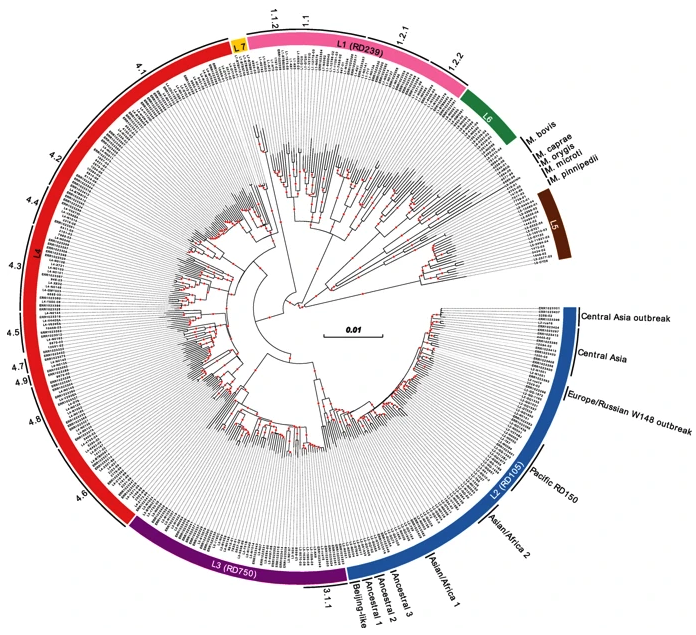
New publication: Phylogenetically informative mutations in genes implicated in antibiotic resistance in Mycobacterium tuberculosis complex

Philip Fowler, 9th March 202016th March 2020

Although the population structure M. tuberculosis is clonal, one must be careful when inferring the effect of individual mutations on the effect of an antibiotic. Purely because a mutation appears to define a phylogeny does not mean it has no effect on the minimum inhibitory concentration.

Read more here (Open Access).

Share this:

  • Click to share on X (Opens in new window) X
  • Click to share on Bluesky (Opens in new window) Bluesky
  • Click to email a link to a friend (Opens in new window) Email
  • Click to share on LinkedIn (Opens in new window) LinkedIn
  • Click to share on Mastodon (Opens in new window) Mastodon

Related

antimicrobial resistance clinical microbiology publication research tuberculosis
Post navigation

Previous post
Next post

Related Posts

antimicrobial resistance

New paper: quantitative measurement of effect of mutations on antibiotics in M. tuberculosis

15th January 202415th January 2024

The CRyPTIC project played a major role in the release by the WHO of their…

Share this:

  • Click to share on X (Opens in new window) X
  • Click to share on Bluesky (Opens in new window) Bluesky
  • Click to email a link to a friend (Opens in new window) Email
  • Click to share on LinkedIn (Opens in new window) LinkedIn
  • Click to share on Mastodon (Opens in new window) Mastodon
Read More
antimicrobial resistance

New preprint: Predicting pyrazinamide resistance in M. tuberculosis using a graph convolutional network

29th October 202530th October 2025

In previous work we’ve used “traditional” machine-learning approaches, like XGBoost, to learn and therefore predict…

Share this:

  • Click to share on X (Opens in new window) X
  • Click to share on Bluesky (Opens in new window) Bluesky
  • Click to email a link to a friend (Opens in new window) Email
  • Click to share on LinkedIn (Opens in new window) LinkedIn
  • Click to share on Mastodon (Opens in new window) Mastodon
Read More
publication

New Publication: Protein crowding affects the organisation of ion channels

3rd December 201729th September 2018

Protein crowding and lipid complexity influence the nanoscale dynamic organization of ion channels in cell…

Share this:

  • Click to share on X (Opens in new window) X
  • Click to share on Bluesky (Opens in new window) Bluesky
  • Click to email a link to a friend (Opens in new window) Email
  • Click to share on LinkedIn (Opens in new window) LinkedIn
  • Click to share on Mastodon (Opens in new window) Mastodon
Read More

Leave a Reply Cancel reply

Your email address will not be published. Required fields are marked *

This site uses Akismet to reduce spam. Learn how your comment data is processed.

Privacy & Cookies: This site uses cookies. By continuing to use this website, you agree to their use.

To find out more, including how to control cookies, see here: Cookie Policy
    ©2025 Fowler Lab | WordPress Theme by SuperbThemes