Automated detection of bacterial growth on 96-well plates (AMyGDA)
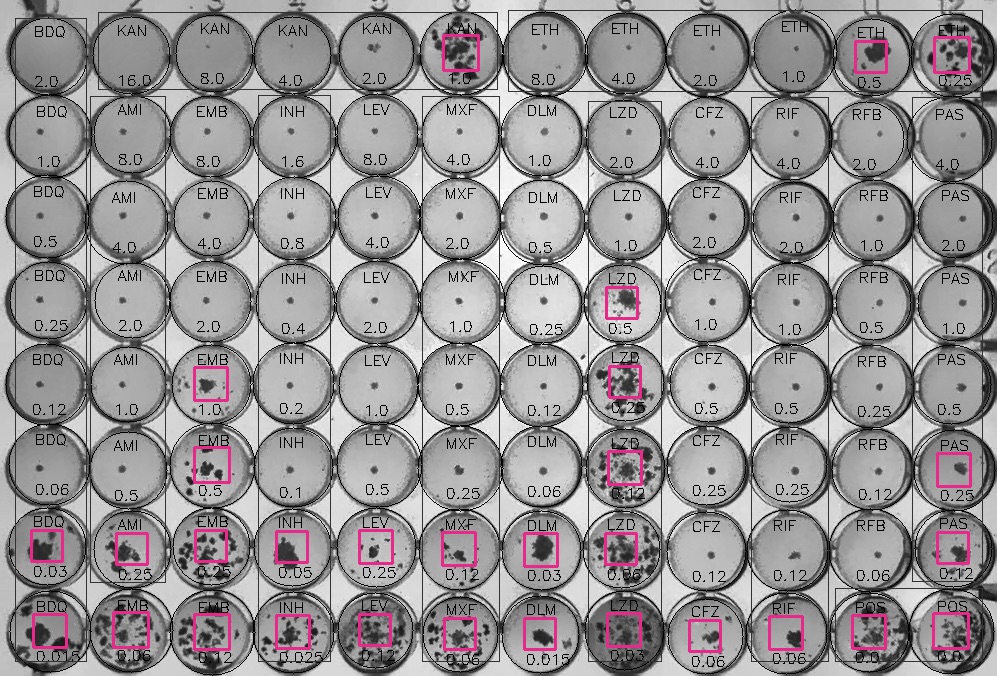
I am involved in an international collaboration, the Comprehensive Resistance Prediction for Tuberculosis: an International Consortium (CRyPTIC), that is collecting 30-50,000 clinical samples from patients with tuberculosis (TB). Although often viewed as a historical disease, TB kills more people globally than any other infectious disease, with 1.7 million people dying from it in 2016. The ultimate goal of CRyPTIC is identify as many of the genetic determinants of antibiotic resistance in TB as possible, thereby enabling the rapid and accurate diagnosis of individual TB cases by examining the genome of the pathogen. Crucially, the clinician is provided with a list of which antibiotics are likely to be effective and which will not. Each sample collected by CRyPTIC therefore has the genome of the infection M. tuberculosis (MTB) pathogen sequenced and its susceptibility to 14 different antibiotics determined using a bespoke 96-well AST plate manufactured by Thermo Fisher. Each plate is inoculated for two weeks and then each well is examined by a laboratory scientist to determine if MTB has grown or not. Since each drug is present at a range of concentrations, the minimum concentration that kills the bacterium can be determined. A photograph of each plate is taken at the point of reading. For more detail, please see my Research page. A potential weakness in this approach is that assessing each plate for growth is a subjective task; often it is straightforward, but some plates are difficult to "read", usually because MTB has not grown well. To allow the project to objectively compare the results of different laboratories I developed some software, called the Automated Mycobacterial Growth Detection Algorithm (AMyGDA), that first processes the photograph to improve contrast, then identifies the location of each well and finally assesses whether MTB is growing in each well. According to our preliminary study, a preprint of which is free to download from the biorXiv, AMyGDA is sufficiently reproducible and agrees well enough with the human readings that we could use to supplement measurement by laboratory scientists in the CRyPTIC project. You can download the AMyGDA software here. It is a python module and instructions on how to install the prerequisites are included, as is a short tutorial and a number of test images. I will be shortly submitting the manuscript to a peer-reviewed journal and I will update this post when it is accepted and published.