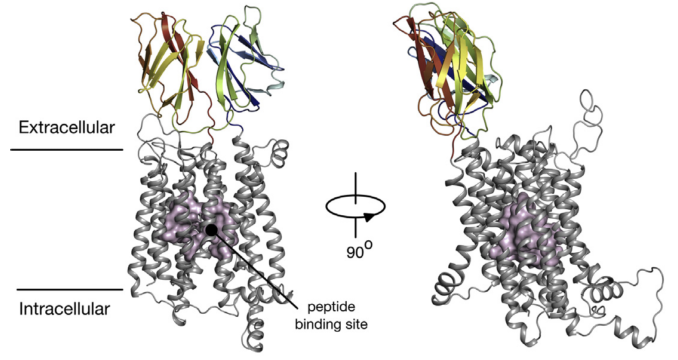
New Publication: The Extra-Cellular Domain of PepT1 and PepT2 Philip Fowler, 2nd November 2015 PepT1 is a nutrient transporter found in the cells that line your small intestine. It is not only responsible for the uptake of di- and tai-peptides, and therefore much of your dietary proteins, but also the uptake of most β-lactam antibiotics. This serendipity ensures that we can take (many of) these important drugs orally. Our ultimate goal is to develop the capability to predict modifications to drug scaffolds that will improve or enable their uptake by PepT1, thereby improving their oral bioavailability. In Structure we report the structures of the extra-cellular domains (ECDs) of PepT1 and PepT2. This is an important milestone on the road to elucidating a structure of PepT1 and allows us to propose the first full-length structural model of PepT1 (see above). Intriguingly, the data also suggests that the ECD also interacts with trypsin, thereby increasing the local concentration of peptides around the transporter, improving its efficiency. Share this: Share on X (Opens in new window) X Share on Bluesky (Opens in new window) Bluesky Email a link to a friend (Opens in new window) Email Share on LinkedIn (Opens in new window) LinkedIn Share on Mastodon (Opens in new window) Mastodon Related publication research
computing New Publication: Predicting affinities for peptide transporters 29th January 201629th September 2018 PepT1 is a nutrient transporter found in the cells that line your small intestine. It… Share this: Share on X (Opens in new window) X Share on Bluesky (Opens in new window) Bluesky Email a link to a friend (Opens in new window) Email Share on LinkedIn (Opens in new window) LinkedIn Share on Mastodon (Opens in new window) Mastodon Read More
publication New Publication: Proteins Alter the Stiffness of Membranes 23rd September 201629th September 2018 Although there have been many studies of proteins whose primary function is to ‘sculpt’ the… Share this: Share on X (Opens in new window) X Share on Bluesky (Opens in new window) Bluesky Email a link to a friend (Opens in new window) Email Share on LinkedIn (Opens in new window) LinkedIn Share on Mastodon (Opens in new window) Mastodon Read More
publication New Publication: NRas slows the rate at which a model lipid bilayer phase separates 13th June 2014 Here we examine by computer simulation what effect adding a small cell-signalling protein does… Share this: Share on X (Opens in new window) X Share on Bluesky (Opens in new window) Bluesky Email a link to a friend (Opens in new window) Email Share on LinkedIn (Opens in new window) LinkedIn Share on Mastodon (Opens in new window) Mastodon Read More