Skip to content
Fowler Lab
Fowler Lab

Predicting antimicrobial resistance

  • News
  • Publications
  • Members
  • Research
    • Overview
    • Manifesto
    • Software
    • Reproducibility
  • Teaching
  • Contact
    • PhDs
  • Wiki
Fowler Lab
Fowler Lab

Predicting antimicrobial resistance

New preprint: using genetics to analyse ESBL infections in a neonatal ICU ward
Philip Fowler, 7th July 20267th July 2026

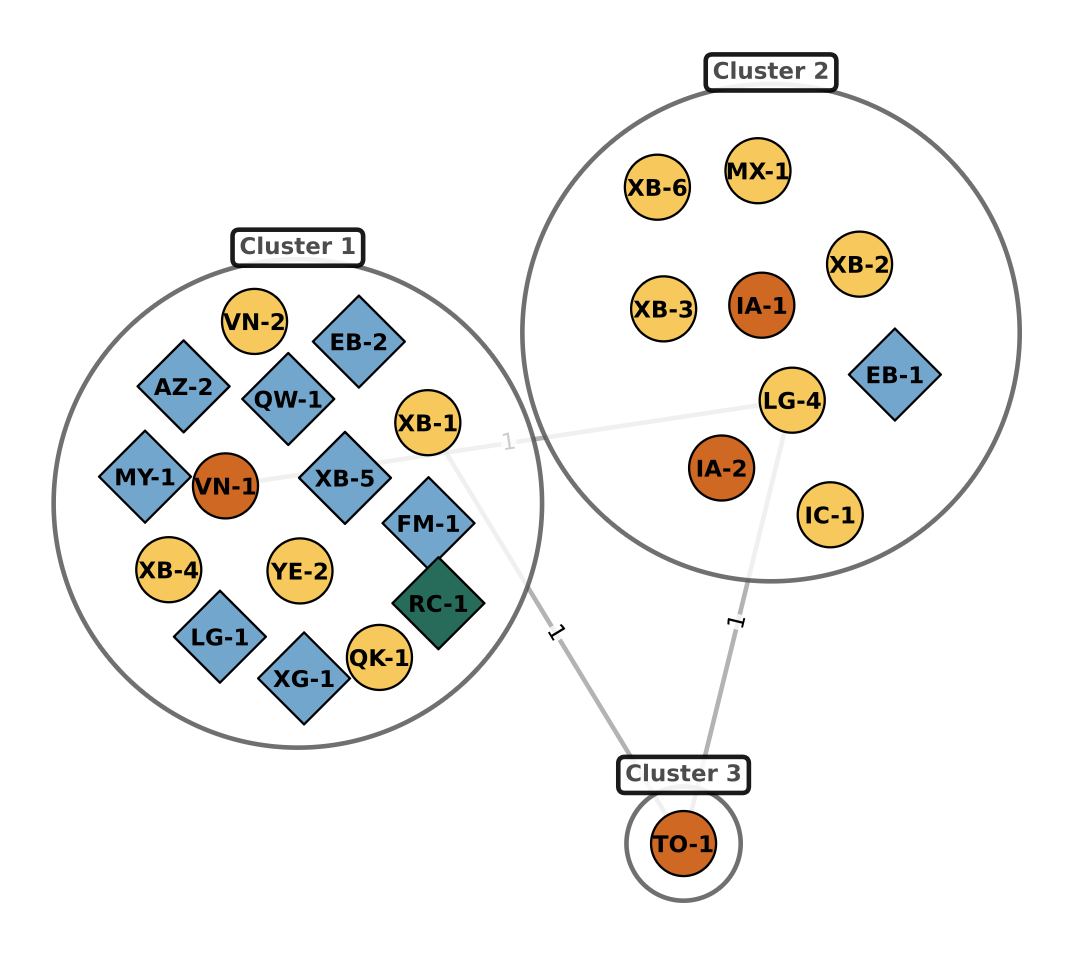
In this preprint, Melody Parker as part of her DPhil, has analysed a series of infections in a neonatal intensive care unit. At the time there was concern that this could be an outbreak; if so the ICU team would want to improve their infection control measures. Whole genome sequencing can give you the really fine-grained resolution to be able to say that these two infections likely came from the same source or, more subtly for Enterobacterales, that the plasmid carrying the AMR gene in these two different species is identical and therefore is likely to have hopped from one to the other in the hospital environment.

Answering these questions is a challenge and required Melody to compare both the chromosomes of the different bacteria in the samples as well as the plasmids. The latter are especially tricky due to how they can shuffle genetic material around, hence she had to use the number of double-cut and joins (measured using pling) as a measure of how similar different plasmids in a community were.

She found no evidence of plasmids containing blaCTX-M alleles moving between species and the data suggested the increase in infections was driven by several small outbreaks of different strains introduced to the ICU from outside.

Share this:

  • Share on X (Opens in new window) X
  • Share on Bluesky (Opens in new window) Bluesky
  • Email a link to a friend (Opens in new window) Email
  • Share on LinkedIn (Opens in new window) LinkedIn
  • Share on Mastodon (Opens in new window) Mastodon

Related

antimicrobial resistance clinical microbiology group publication research

Post navigation

Previous post

Related Posts

publication

New Publication: Protein crowding affects the organisation of ion channels

3rd December 201729th September 2018

Protein crowding and lipid complexity influence the nanoscale dynamic organization of ion channels in cell…

Share this:

  • Share on X (Opens in new window) X
  • Share on Bluesky (Opens in new window) Bluesky
  • Email a link to a friend (Opens in new window) Email
  • Share on LinkedIn (Opens in new window) LinkedIn
  • Share on Mastodon (Opens in new window) Mastodon
Read More
antimicrobial resistance

Diagnosing antibiotic resistance: future trends?

23rd April 20175th August 2018

It is Sunday, I’m in Vienna at the European Congress of Clinical Microbiology and Infectious…

Share this:

  • Share on X (Opens in new window) X
  • Share on Bluesky (Opens in new window) Bluesky
  • Email a link to a friend (Opens in new window) Email
  • Share on LinkedIn (Opens in new window) LinkedIn
  • Share on Mastodon (Opens in new window) Mastodon
Read More
antimicrobial resistance

New publication: Phylogenetically informative mutations in genes implicated in antibiotic resistance in Mycobacterium tuberculosis complex

9th March 202016th March 2020

Although the population structure M. tuberculosis is clonal, one must be careful when inferring the…

Share this:

  • Share on X (Opens in new window) X
  • Share on Bluesky (Opens in new window) Bluesky
  • Email a link to a friend (Opens in new window) Email
  • Share on LinkedIn (Opens in new window) LinkedIn
  • Share on Mastodon (Opens in new window) Mastodon
Read More

Leave a Reply Cancel reply

Your email address will not be published. Required fields are marked *

This site uses Akismet to reduce spam. Learn how your comment data is processed.

Privacy & Cookies: This site uses cookies. By continuing to use this website, you agree to their use.

To find out more, including how to control cookies, see here: Cookie Policy
    ©2026 Fowler Lab | WordPress Theme by SuperbThemes