Skip to content
Fowler Lab
Fowler Lab

Predicting antimicrobial resistance

  • News
  • Publications
  • Members
  • Research
    • Overview
    • Manifesto
    • Software
    • Reproducibility
  • Teaching
  • Contact
    • PhDs
  • Wiki
Fowler Lab
Fowler Lab

Predicting antimicrobial resistance

NIHR PPI In Action Webinar on BashTheBug
Philip Fowler, 1st June 20261st June 2026

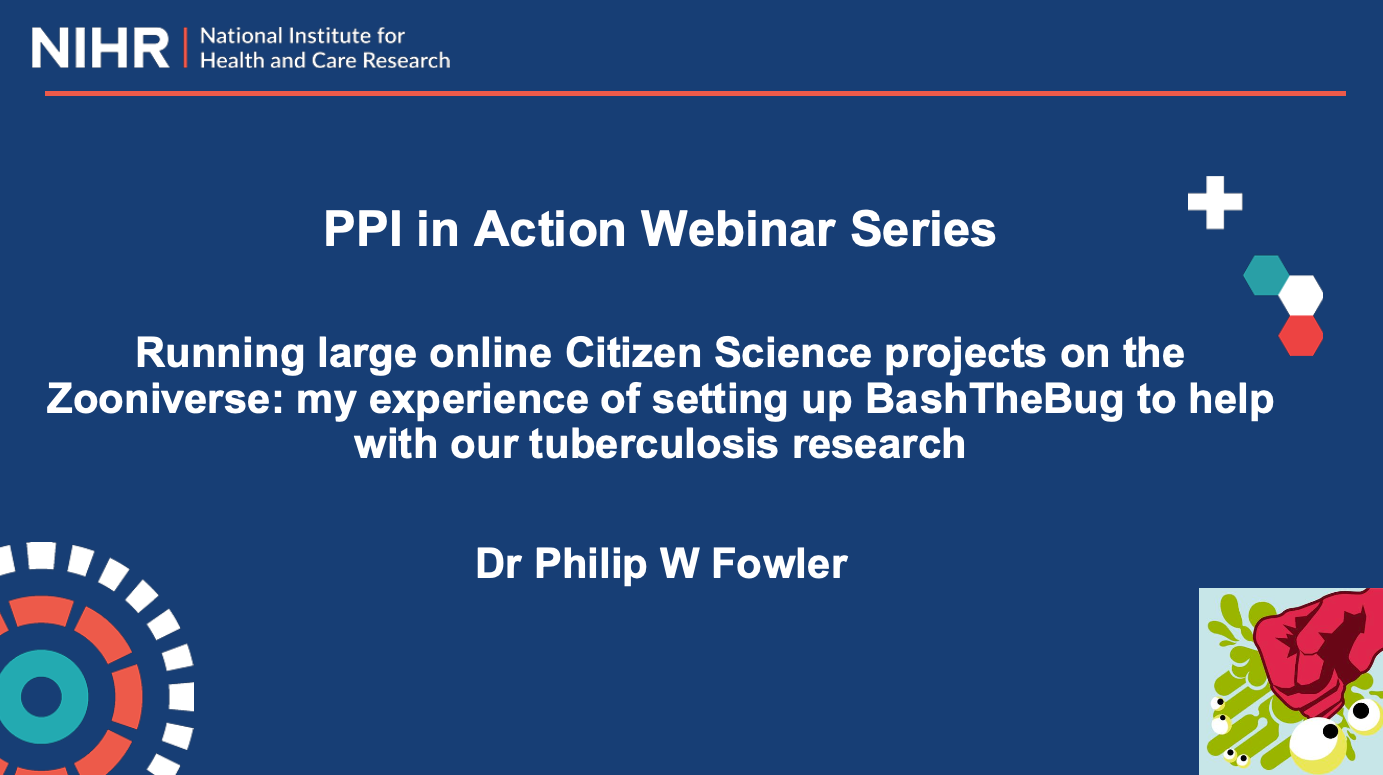
As part of the NIHR’s “PPI In Action” series, Philip Fowler gave a webinar on Friday 22 May 2026 entitled:

Running large online Citizen Science projects on the Zooniverse: my experience of setting up BashTheBug to help with our tuberculosis research.

He talked about what problem we asked the citizen scientists to help us solve, how the Zooniverse works , from both the perspective of a citizen scientist and a scientist setting up a project, and the two subsequent Zooniverse projects that have been successfully run out of our Unit.

The webinar is now available via NIHRtv on YouTube.

During the four years it was running, 46,427 people contributed to BashTheBug and collectively they classified 4,746,420 images of M. tuberculosis growing on different concentrations of one of 13 antibiotics. Their consensus readings were very consistent and were combined with the original readings taken by the laboratory scientists, as well as AMyGDA and, more recently, a machine learning algorithm, TMAS, to reduce the measurement error in the dataset of >20,000 clinical tuberculosis samples collected by the CRyPTIC project.

You can read more about CRyPTIC here and download the latest dataset (v3.4.0), which includes all the classifications made by all the citizen scientists from Zenodo.

Share this:

  • Share on X (Opens in new window) X
  • Share on Bluesky (Opens in new window) Bluesky
  • Email a link to a friend (Opens in new window) Email
  • Share on LinkedIn (Opens in new window) LinkedIn
  • Share on Mastodon (Opens in new window) Mastodon

Related

antimicrobial resistance citizen science tuberculosis

Post navigation

Previous post
Next post

Related Posts

antimicrobial resistance

Diagnosing antibiotic resistance: future trends?

23rd April 20175th August 2018

It is Sunday, I’m in Vienna at the European Congress of Clinical Microbiology and Infectious…

Share this:

  • Share on X (Opens in new window) X
  • Share on Bluesky (Opens in new window) Bluesky
  • Email a link to a friend (Opens in new window) Email
  • Share on LinkedIn (Opens in new window) LinkedIn
  • Share on Mastodon (Opens in new window) Mastodon
Read More
antimicrobial resistance

I’ve moved…

14th March 20165th August 2018

Today is my first day as a Senior Researcher in Modernising Medical Microbiology in the…

Share this:

  • Share on X (Opens in new window) X
  • Share on Bluesky (Opens in new window) Bluesky
  • Email a link to a friend (Opens in new window) Email
  • Share on LinkedIn (Opens in new window) LinkedIn
  • Share on Mastodon (Opens in new window) Mastodon
Read More

New publication: WHO catalogue of Mycobacterium tuberculosis resistant mutations

28th March 202228th March 2022

The CRyPTIC project collecting over 20,000 clinical samples of TB and for each, sequencing its…

Share this:

  • Share on X (Opens in new window) X
  • Share on Bluesky (Opens in new window) Bluesky
  • Email a link to a friend (Opens in new window) Email
  • Share on LinkedIn (Opens in new window) LinkedIn
  • Share on Mastodon (Opens in new window) Mastodon
Read More

Leave a Reply Cancel reply

Your email address will not be published. Required fields are marked *

This site uses Akismet to reduce spam. Learn how your comment data is processed.

Privacy & Cookies: This site uses cookies. By continuing to use this website, you agree to their use.

To find out more, including how to control cookies, see here: Cookie Policy
    ©2026 Fowler Lab | WordPress Theme by SuperbThemes