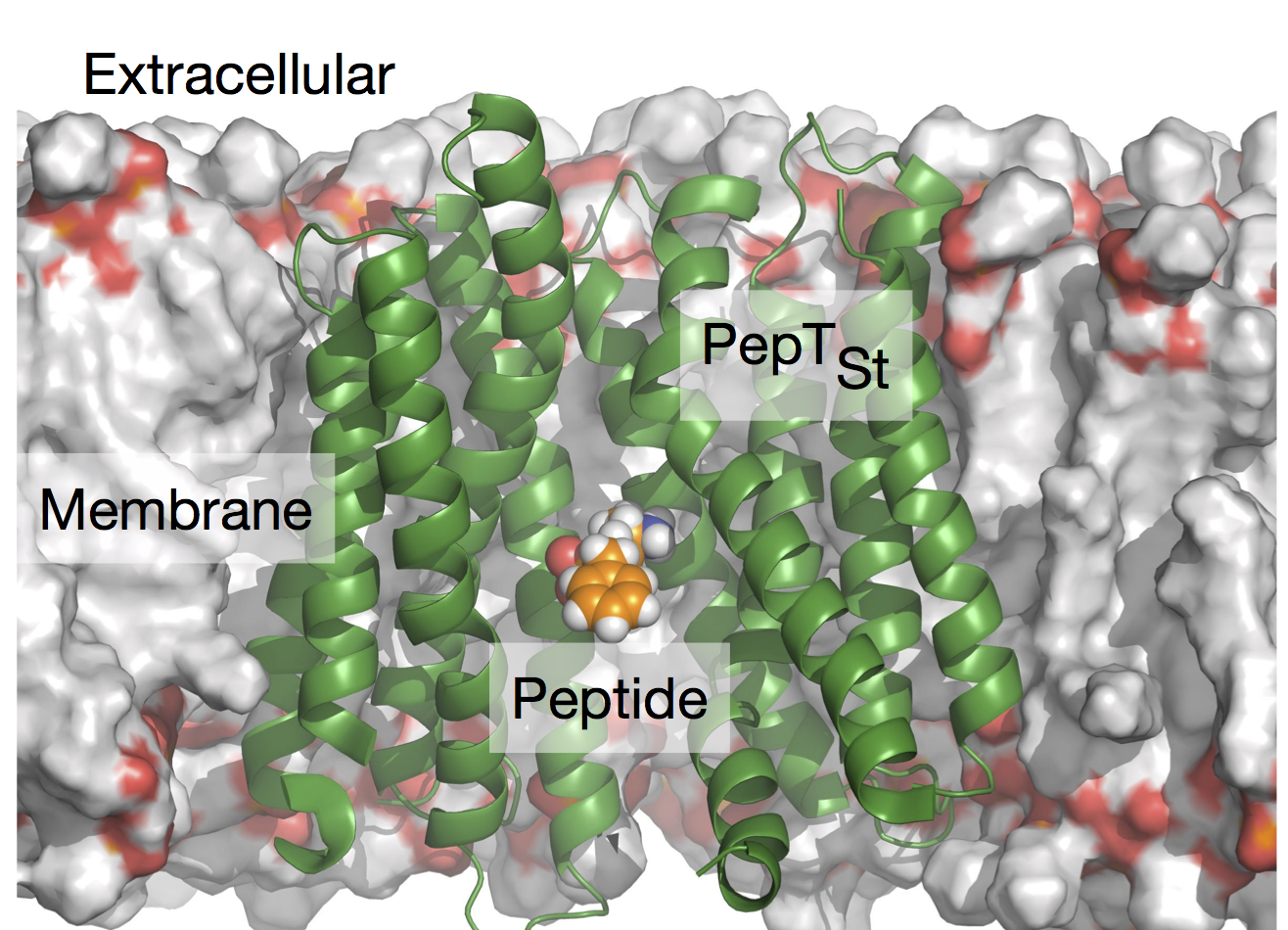
New Publication: Predicting affinities for peptide transporters Philip Fowler, 29th January 201629th September 2018 PepT1 is a nutrient transporter found in the cells that line your small intestine. It is not only responsible for the uptake of di- and tai-peptides, and therefore much of your dietary proteins, but also the uptake of most β-lactam antibiotics. This serendipity ensures that we can take (many of) these important drugs orally. Our ultimate goal is to develop the capability to predict modifications to drug scaffolds that will improve or enable their uptake by PepT1, thereby improving their oral bioavailability. In this paper, just published online in the new journal Cell Chemical Biology (and free to download, thanks to the Wellcome Trust), we show that it is possible to predict how well a series of di- and tai-peptides bind to a bacterial homologue of PepT1 using a hierarchical approach that combines an end-point free energy method with thermodynamic integration. Since there is no structure of PepT1, we then tried our method on a homology model we have published in 2015. We found that method lost its predictive power. By studying a range of homology models of intermediate quality, we showed that it is highly likely an experimental structure of hPepT1 will be required for in silico accurate predictions of transport. This is the second paper that Firdaus Samsudin has published as part of his DPhil here in Oxford. Share this: Share on X (Opens in new window) X Share on Bluesky (Opens in new window) Bluesky Email a link to a friend (Opens in new window) Email Share on LinkedIn (Opens in new window) LinkedIn Share on Mastodon (Opens in new window) Mastodon Related computing molecular dynamics publication research
New preprint: validating antibiotic resistance prediction in our Myco pipeline 9th November 202413th January 2025 Over the last 18 months or so we’ve been designing, coding and testing a Mycobacterial… Share this: Share on X (Opens in new window) X Share on Bluesky (Opens in new window) Bluesky Email a link to a friend (Opens in new window) Email Share on LinkedIn (Opens in new window) LinkedIn Share on Mastodon (Opens in new window) Mastodon Read More
computing CECAM Macromolecular simulation software workshop 14th July 2015 I’m co-organiser of this slightly-different CECAM workshop in October 2015 at the Forschungszentrum Jülich, Germany. Rather than following the… Share this: Share on X (Opens in new window) X Share on Bluesky (Opens in new window) Bluesky Email a link to a friend (Opens in new window) Email Share on LinkedIn (Opens in new window) LinkedIn Share on Mastodon (Opens in new window) Mastodon Read More
publication New Publication: Membrane Compartmentalization Reduces the Mobility of Lipids. 23rd September 201629th September 2018 Lipids are not free to diffuse around the cell membrane. Rather they are constrained not… Share this: Share on X (Opens in new window) X Share on Bluesky (Opens in new window) Bluesky Email a link to a friend (Opens in new window) Email Share on LinkedIn (Opens in new window) LinkedIn Share on Mastodon (Opens in new window) Mastodon Read More