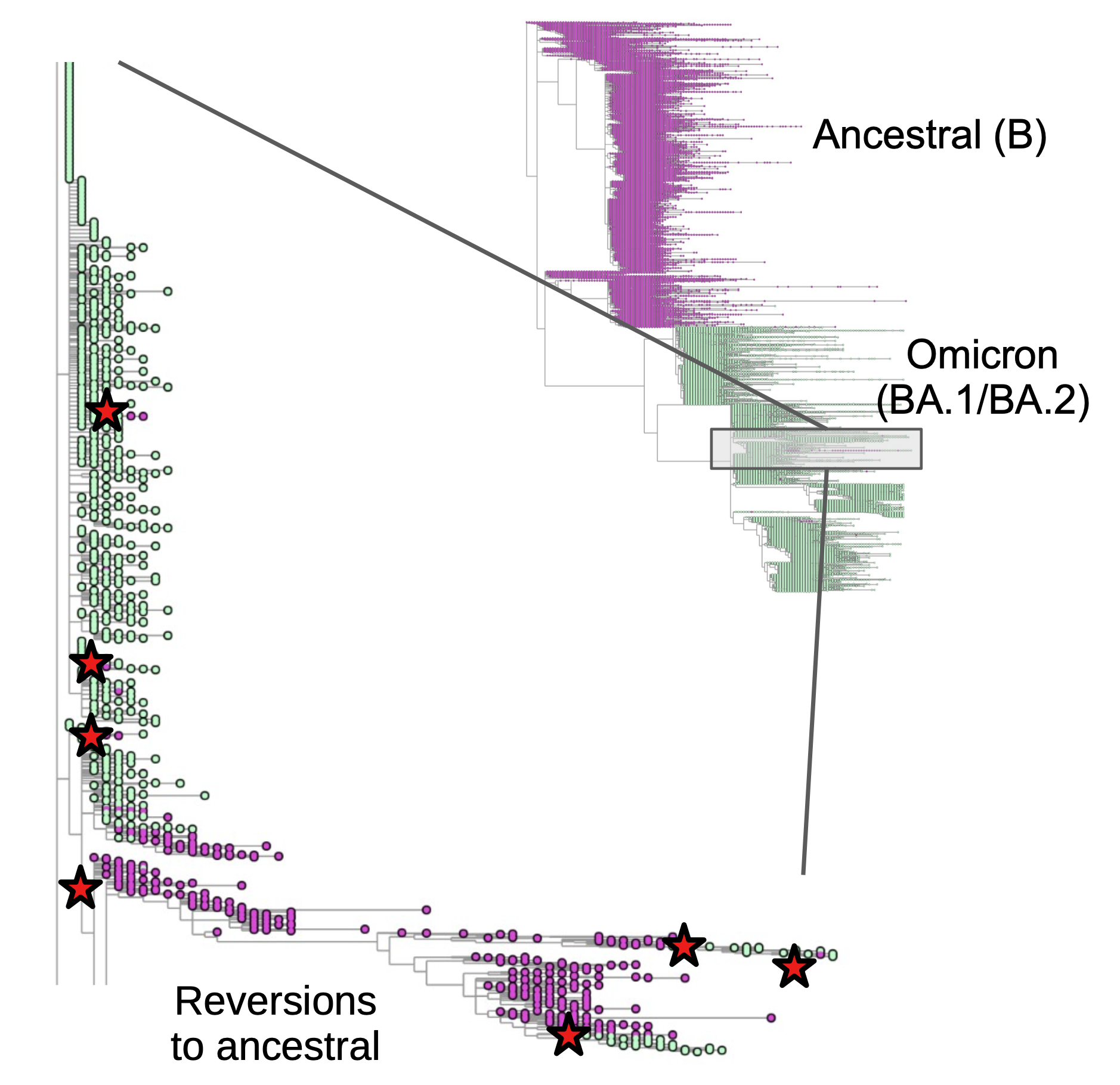
New preprint: processing 3.9 million SARS-CoV-2 samples to make a consistent phylogenetic tree Philip Fowler, 7th May 20247th May 2024 Martin Hunt, Zam Iqbal and lots of others have written an epic preprint where they describe their variant caller, viridian, that was written expressly for producing a consensus genome for a virus using tiled amplicon sequencing. We deployed viridian into our cloud-based sequencing platform during the pandemic and several of us are co-authors on the preprint. Rather than just write a straightforward methods paper, they choose to take it a few steps further and download all the publicly available SARS-CoV-2 FASTQ files from the ENA (which was about 3.9 million) and process them with viridian and then build a phylogenetic tree that is missing some of the artefacts that plague the trees if you simply take FASTA files that have been deposited using a range of genetic pipelines. Share this: Share on X (Opens in new window) X Share on Bluesky (Opens in new window) Bluesky Email a link to a friend (Opens in new window) Email Share on LinkedIn (Opens in new window) LinkedIn Share on Mastodon (Opens in new window) Mastodon Related clinical microbiology gpas
antimicrobial resistance New paper: how well can we predict AMR in tuberculosis samples? 16th December 202516th December 2025 This paper just published in Microbial Genomics examines how well our software tool, gnomonicus, predicts… Share this: Share on X (Opens in new window) X Share on Bluesky (Opens in new window) Bluesky Email a link to a friend (Opens in new window) Email Share on LinkedIn (Opens in new window) LinkedIn Share on Mastodon (Opens in new window) Mastodon Read More
clinical microbiology New preprint: processing SARS-CoV-2 genetics in the cloud 31st January 202431st January 2024 In this preprint, we describe how in July 2022 for two weeks seven sites in… Share this: Share on X (Opens in new window) X Share on Bluesky (Opens in new window) Bluesky Email a link to a friend (Opens in new window) Email Share on LinkedIn (Opens in new window) LinkedIn Share on Mastodon (Opens in new window) Mastodon Read More
citizen science Automated detection of bacterial growth on 96-well plates (AMyGDA) 11th December 20175th August 2018 I am involved in an international collaboration, the Comprehensive Resistance Prediction for Tuberculosis: an International Consortium… Share this: Share on X (Opens in new window) X Share on Bluesky (Opens in new window) Bluesky Email a link to a friend (Opens in new window) Email Share on LinkedIn (Opens in new window) LinkedIn Share on Mastodon (Opens in new window) Mastodon Read More