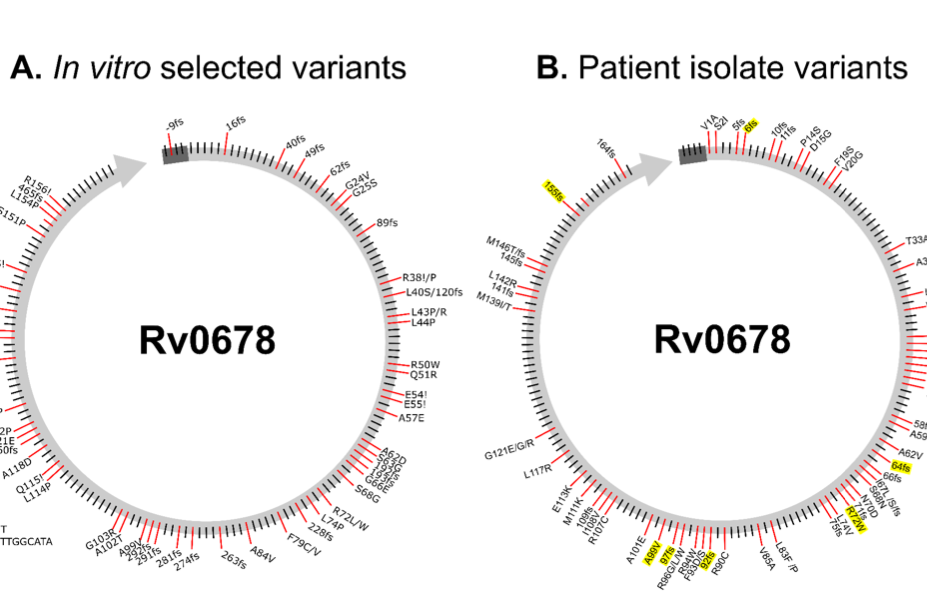
New preprint: Deciphering bedaquiline and clofazimine resistance in tuberculosis Philip Fowler, 22nd March 202122nd March 2021 In this preprint we examine 14,151 clinical isolates drawn from the CRyPTIC dataset. Each isolate had its minimum inhibitory concentration (MIC) to bedaquiline and clofazimine measured and hence we were able to identify the transcription regulator Rv0678, as the current main source of elevated MICs to both these drugs. Lindsay Sonnenkalb, who is studying for her PhD with Stefan Niemann, then evolved Mycobacterium tuberculosis strains under sub-lethal concentrations of both compounds and was able to identify 189 different Rv0678 genetic variants that confer elevated MICs to bedaquiline and clofazimine. Detailed modelling of the protein structure allowed us to posit four main resistance mechanisms: impairment of DNA binding, reduction in protein stability, disruption of protein dimerization, and reduction in affinity for its fatty acid ligand. Share this: Share on X (Opens in new window) X Share on Bluesky (Opens in new window) Bluesky Email a link to a friend (Opens in new window) Email Share on LinkedIn (Opens in new window) LinkedIn Share on Mastodon (Opens in new window) Mastodon Related antimicrobial resistance clinical microbiology publication
antimicrobial resistance New Publication: Predicting whether mutations confer resistance to an antibiotic 5th January 201829th September 2018 Due to the rise of antibiotic resistance, it is increasingly important that your clinician knows… Share this: Share on X (Opens in new window) X Share on Bluesky (Opens in new window) Bluesky Email a link to a friend (Opens in new window) Email Share on LinkedIn (Opens in new window) LinkedIn Share on Mastodon (Opens in new window) Mastodon Read More
antimicrobial resistance New publication: Reconciling the potentially irreconcilable? Genotypic and phenotypic amoxicillin-clavulanate resistance in Escherichia coli. 30th March 202022nd August 2020 Clinical microbiology often assumes a sample is resistant or susceptible. Making such a classification relies… Share this: Share on X (Opens in new window) X Share on Bluesky (Opens in new window) Bluesky Email a link to a friend (Opens in new window) Email Share on LinkedIn (Opens in new window) LinkedIn Share on Mastodon (Opens in new window) Mastodon Read More
New preprint: evaluating a laboratory workflow for sequencing Mycobacteria using long-read sequencing 7th February 20269th April 2026 In this preprint, we describe and evaluate a laboratory workflow for sequencing Mycobacterial samples using… Share this: Share on X (Opens in new window) X Share on Bluesky (Opens in new window) Bluesky Email a link to a friend (Opens in new window) Email Share on LinkedIn (Opens in new window) LinkedIn Share on Mastodon (Opens in new window) Mastodon Read More