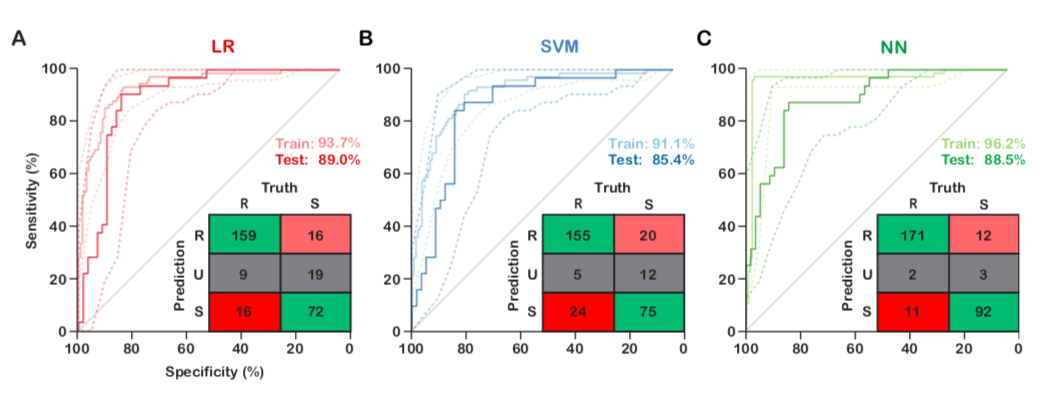
New preprint: Predicting pyrazinamide resistance by machine learning Philip Fowler, 29th April 201929th April 2019 Usually, the protein that an antibiotic binds is essential for bacterial survival, which is how the drug has its effect. In this case, relatively few protein mutations arise that confer resistance, they are often subtle in nature and one can try to predict the phenotype of a protein mutation by considering how it affects the binding free energy of an antibiotic. Resistance to pyrazinamide (PZA), which is a first-line anti-tuberculosis compound, mainly arises via genetic variation in the pncA gene, which, unusually, is not essential in M. tuberculosis. One finds a wide range of genetic variation in clinical samples, from missense mutations to insertions and deletions and even the insertion of stop codons. This makes building a catalogue that specifies the effect of each genetic variant on the action of PZA more challenging since one has to classify many more variants. A current leading resistance catalogue specifies the effect of over 450 pncA single nucleotide polymorphisms yet even that level of detail only allows a prediction to be made for 75% of clinical samples. In this preprint, Josh Carter has applied several Machine Learning methods to a curated, high-quality set of pncA mutations and, by including a range of structural and chemical features, is able to predict the effect of pncA missense mutations to a good degree of sensitivity and specificity. One application of this model would be to provide a preliminary classification for the 25% of clinical samples that the heuristic catalogues cannot make a prediction. Share this: Share on X (Opens in new window) X Share on Bluesky (Opens in new window) Bluesky Email a link to a friend (Opens in new window) Email Share on LinkedIn (Opens in new window) LinkedIn Share on Mastodon (Opens in new window) Mastodon Related antimicrobial resistance clinical microbiology publication research tuberculosis
antimicrobial resistance FowlerLab at ESM 2024 1st July 20241st July 2024 Three of us (Dylan Adlard, Dylan Dissanayake and Philip Fowler) attended the 44th Congress of… Share this: Share on X (Opens in new window) X Share on Bluesky (Opens in new window) Bluesky Email a link to a friend (Opens in new window) Email Share on LinkedIn (Opens in new window) LinkedIn Share on Mastodon (Opens in new window) Mastodon Read More
publication New Publication: State-Dependent Network Connectivity Determines Gating in a K+ Channel 27th June 2014 In an earlier paper we showed that the closed state of Kir1.1, a important potassium… Share this: Share on X (Opens in new window) X Share on Bluesky (Opens in new window) Bluesky Email a link to a friend (Opens in new window) Email Share on LinkedIn (Opens in new window) LinkedIn Share on Mastodon (Opens in new window) Mastodon Read More
New publication: Predicting antibiotic resistance in complex protein targets using alchemical free energy methods 26th August 202224th October 2022 In this paper, Alice Brankin calculates how different mutations in the DNA gyrase affect the… Share this: Share on X (Opens in new window) X Share on Bluesky (Opens in new window) Bluesky Email a link to a friend (Opens in new window) Email Share on LinkedIn (Opens in new window) LinkedIn Share on Mastodon (Opens in new window) Mastodon Read More